October 29, 2026
Kakko-EV base-con
A Revolution in Residential EV Infrastructure:
“Simple, Logical, and Groundbreaking”
Introducing (EV) Kakko-EV, A Next-Generation System Solving EV Charging Challenges in Both Existing and New Multifamily Residences
Bringing Home Charging to Multifamily Housing by Synchronizing with Scheduled Large-Scale Renovations in Existing Properties and Embedding from the Foundation Stage in New Constructions
KUMAMOTO, JAPAN — Kakko-EV base-con Inc. today announced the launch of (EV) Kakko-EV, a new framework designed to address the challenges of implementing electric vehicle (EV) charging infrastructure across multifamily housing, including condominiums and apartments.
Redefining EV Infrastructure in Multifamily Housing: “Simple, Logical, and Groundbreaking”
The configuration for both new and existing apartments includes a proprietary distribution board with an integrated magnetic contactor, as well as a 24-household junction box, combined with (EV) Base-Con or other utility infrastructure, depending on the installation environment. By leveraging the opportunity of large-scale repairs in existing properties and anticipating future charging equipment installation from the planning and exterior construction stages in new builds, we will advance the nationwide rollout and adoption of a framework that makes it easier to establish EV charging environments in multifamily housing.
Case Study: Ongoing Installation at a New Rental Property in Chuo Ward, Kumamoto City
(EV) Kakko-EV is currently being installed at a newly constructed rental property in Chuo Ward, Kumamoto City. The planned property is a 12-story building with 33 housing units and 29 parking stalls, with structural formwork progressing on the fifth floor. Serving as a case study that integrates EV charging infrastructure from the new-construction stage, we aim to expand this approach for future new developments.
A new form of EV charging that transforms the future of apartments
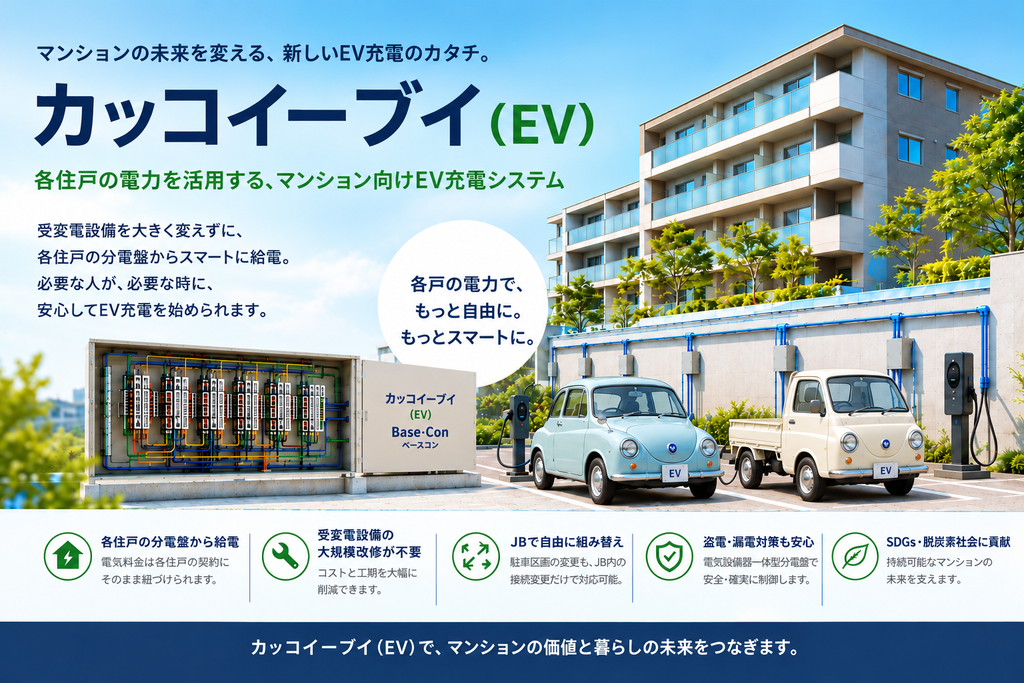
Kakko-EV (EV)
An EV charging system for apartments utilizing electricity from individual households.
Intelligently supplying power from each household’s distribution board without major modifications to existing substation/transformer equipment,
Whoever needs it, whenever they need it, can begin charging their EV with peace of mind.
More freely and more intelligently with each household’s own power.
- Power supply from each household’s distribution boards
- Electricity costs are linked directly to each housing unit’s contracts
- No need for large-scale substation/transformer equipment upgrades
- Substantially reduces costs and construction schedules
- Flexible reconfiguration via the junction box
- Changes in parking space assignments can be handled by simply rewiring connections inside the junction box
- Peace of mind against power theft and leakage
- Safely and reliably controlled via the magnetic contactor-integrated distribution board
- Contributing to SDGs & a decarbonized society
- Supporting a sustainable future for apartments
Connecting property value with the future of daily living through Kakko-EV (EV).
Note: (EV) Kakko-EV is not a standalone charging appliance, but a framework and systems engineering model designed to build charging environments leveraging existing electrical capacities. The magnetic contactor-integrated distribution board and 24-household junction box form the baseline standard for both new and existing properties, with (EV) Base-Con implemented according to specific parking and structural layouts.
Background: Surging Demand for EV Charging Across Existing and New Multifamily Housing
The Japanese government has set targets to deploy 300,000 EV charging ports by 2030 and established a policy aiming for electrified vehicles (including HEVs) to account for 100% of new passenger car sales by 2035. In multifamily housing, however, hurdles to adoption include installing charging equipment for individual housing units, wiring work through common areas, the electrical capacity of substation/transformer equipment, and establishing frameworks for cost allocation and management. While existing properties require construction plans tailored to the specific condition of each building as well as consensus-building within the homeowners’ associations, in new builds, it is crucial to anticipate future EV charging installations from the design and exterior construction stages. We propose EV infrastructure development tailored to each building’s lifecycle stage, combining power supply methods for existing buildings with scheduled large-scale renovation opportunities and providing pre-embedded foundations such as (EV) Base-Con for new construction.
Features of (EV) Kakko-EV
1. Power from Individual Households’ Distribution Boards
As a baseline configuration, power for charging equipment is routed from each household’s distribution boards, assessed against their contracted electrical capacity and electrical equipment specifications. This can potentially eliminate the necessity for substation/transformer equipment upgrades across the entire complex. Preliminary on-site assessments and technical checks are conducted before installation.
2. A Clear Framework for Separating Electricity Fees and Cost Allocation
Because the system utilizes electricity from each household, electricity fees for charging power are calculated based on each household’s existing electricity contract and paid by the user. This structure makes it easier to keep charging costs down compared to public charging services. Equipment and installation costs for common areas are organized according to building conditions and agreements reached by the homeowners’ associations, aiming for an implementation that ensures fairness.
3. Junction Box Built for Scalability
As a core component of our proprietary model, Kakko-EV base-con proposes a 24-household junction box. Utilizing commercially available boxes and standard terminal boards, it is engineered for scalability through horizontal and vertical interconnection. The system is designed so that changes in parking space assignments can be handled through wiring adjustments according to on-site conditions.
4. Reduced Installation Burden by Synchronizing with Major Renovations
For existing properties, coordinating installation with scheduled repairs allows the work to take advantage of scaffolding, exterior wall repairs/painting, and asphalt restoration, aiming to curb installation costs compared to standalone construction. Actual construction methods and expenses vary depending on building structure, wiring routes, and site conditions.
5. Future-Proofing New Properties with (EV) Base-Con Pre-Embedded Foundations and Magnetic Contactor-Integrated Distribution Boards
For new properties, Kakko-EV base-con proposes infrastructure development that anticipates future EV charging installations by pairing (EV) Base-Con—a precast concrete foundation installed during exterior works—with magnetic contactor-integrated distribution boards installed inside housing units. By preparing both foundation structures and electrical equipment from the building’s planning and design stages, this framework supports creating an environment where future charging equipment can be smoothly introduced.
Through collaboration with Kumamoto Fuji Concrete Industry Co., Ltd., Kakko-EV base-con aims to promote the development of apartments built with EV readiness from day one.
6. Wiring Options Using Pillars and Railings in Self-Park Garages
In self-park garages, installing (EV) Base-Con into the ground can be difficult due to structural and pavement constraints. In such cases, we consider utilizing existing pillars and railings inside the parking facility as mounting points for outlets, routed via overhead wiring.
For both new and existing properties, while the magnetic contactor-integrated distribution board and 24-household junction box serve as the baseline setup, the feasibility of (EV) Base-Con and specific conduit pathways are determined after verifying parking structure, safety, and construction conditions. Specific methods are planned after on-site surveys to ensure compliance with relevant laws, regulations, and technical standards.
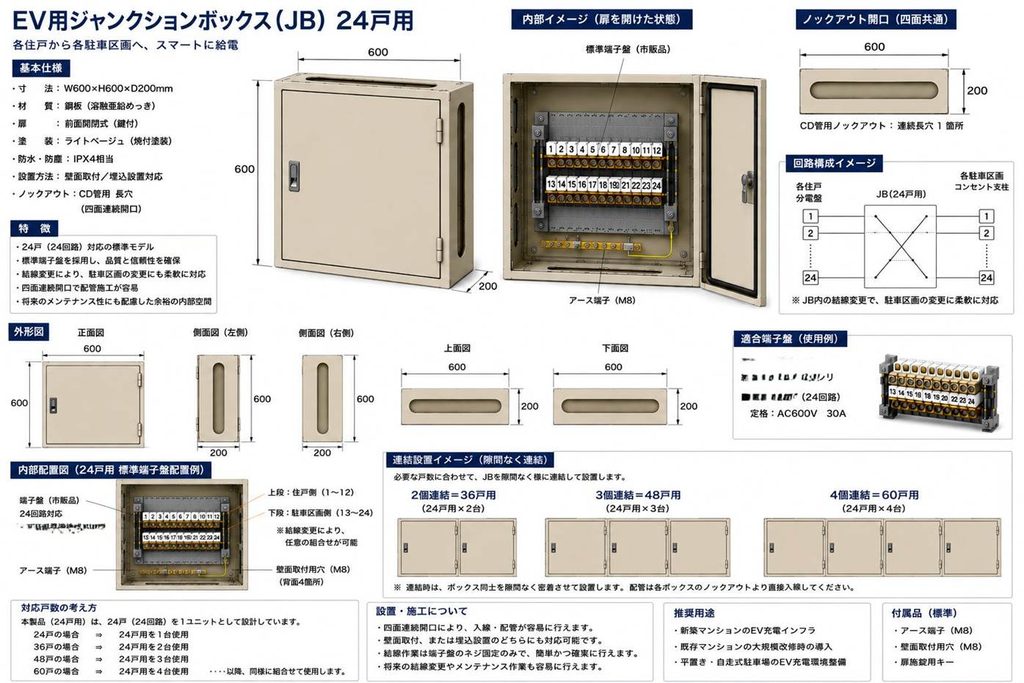
EV Junction Box for 24 Households
Smart Power Distribution from Each Housing Unit to Each Parking Space
Basic Specifications:
- Dimensions: W600 × H600 × D200 mm
- Material: Steel sheet (hot-dip galvanized)
- Door: Front-opening hinged door (keyed lock included)
- Finish: Light beige (baked enamel finish)
- Ingress protection: IPX4 equivalent
- Mounting method: Compatible with both surface wall-mounting and semi-recessed installation
- Knockouts: Elongated slotted holes for CD conduits (continuous openings on all 4 sides)
Key Features:
- Standard model supporting 24 housing units (24 circuits)
- Employ standard commercial terminal blocks to ensure high quality and reliability
- Parking space reallocations can be easily adapted by simply rerouting wire terminals within the box
- 4-sided continuous knockout openings make conduit and piping installation straightforward
- Spacious interior design engineered for ease of future maintenance and inspection
External Dimensions:
- Front
- Side (left)
- Side (right)
- Top
- Bottom
Knockout Openings (Common to All 4 Sides):
- Knockout for CD conduit: 1 continuous elongated opening per side
Circuit Configuration:
- Individual household unit distribution board
- Junction box for 24 households
- Parking space outlets
- Reallocating parking spaces is flexibly accommodated through wiring changes inside the junction box
Compatible Terminal Block (Example):
- (24 circuits)
- Rating: AC 600V, 30A
Internal Layout (24-Household Standard Terminal Block)
- Commercial terminal block
- Compatible with 24 circuits
- M8 Earth terminal
- Upper row: Housing unit side (Circuits 1–12)
- Lower row: Parking space side (Circuits 13–24)
- Arbitrary terminal combinations can be configured via rewiring
- 4 × M8 wall-mount holes located on the rear panel
How to Calculate Households
This product (for 24 households) is designed with 24 households (24 circuits) as 1 unit
- For 24 households: Use 1 × 24-household junction box
- For 36 households: Use 2 × 24-household junction boxes
- For 48 households: Use 3 × 24-household junction boxes
- For 60 households: Use 4 × 24-household junction boxes
(Scales continuously upward by grouping modules according to property requirements)
Grouped Installation Guidance:
- Install the number of junction boxes needed for the number of households without leaving gaps.
- Group of 2 = 36 households (24-household x 2)
- Group of 3 = 48 households (24-household x 3)
- Group of 4 = 60 households (24-household x 4)
- Mount junction boxes directly against each other without leaving gaps. Route electrical conduits directly into each enclosure through the knockouts.
Installation and Construction:
- Continuous knockouts on all four sides ensure effortless wire pulling and conduit entry
- Adaptable to either surface wall mounting or semi-recessed embedding
- Wiring is performed simply and securely using standard terminal screw fasteners
- Smooth and simple future terminal adjustments, as well as regular inspections
Recommended Applications:
- EV charging infrastructure for new apartment construction
- Integration during scheduled large-scale exterior renovations of existing apartments
- EV charging deployment across flat surface lots and self-park/multi-story parking structures
Accessories Included (Standard):
- Earth terminal (M8)
- Wall mounting holes (M8)
- Front door lock key
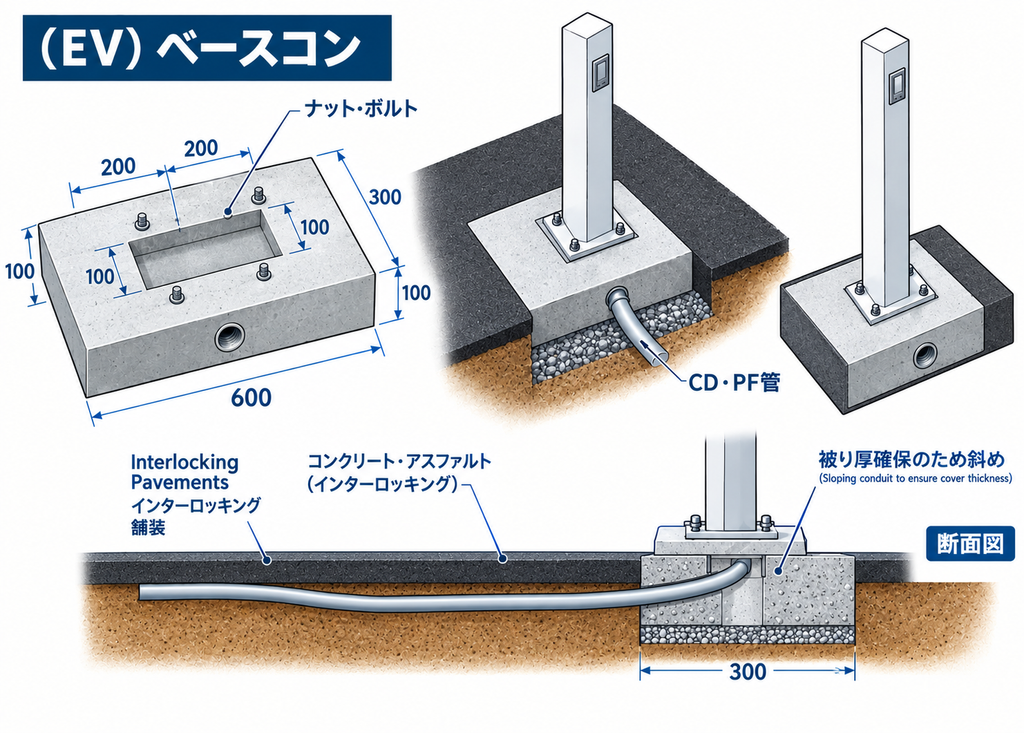
(EV) Base-Con
- Nuts and bolts
- CD / PF conduit
- Cross-Section View
- Interlocking Pavements
- Concrete / Asphalt (Interlocking)
- Sloping conduit to ensure cover thickness):
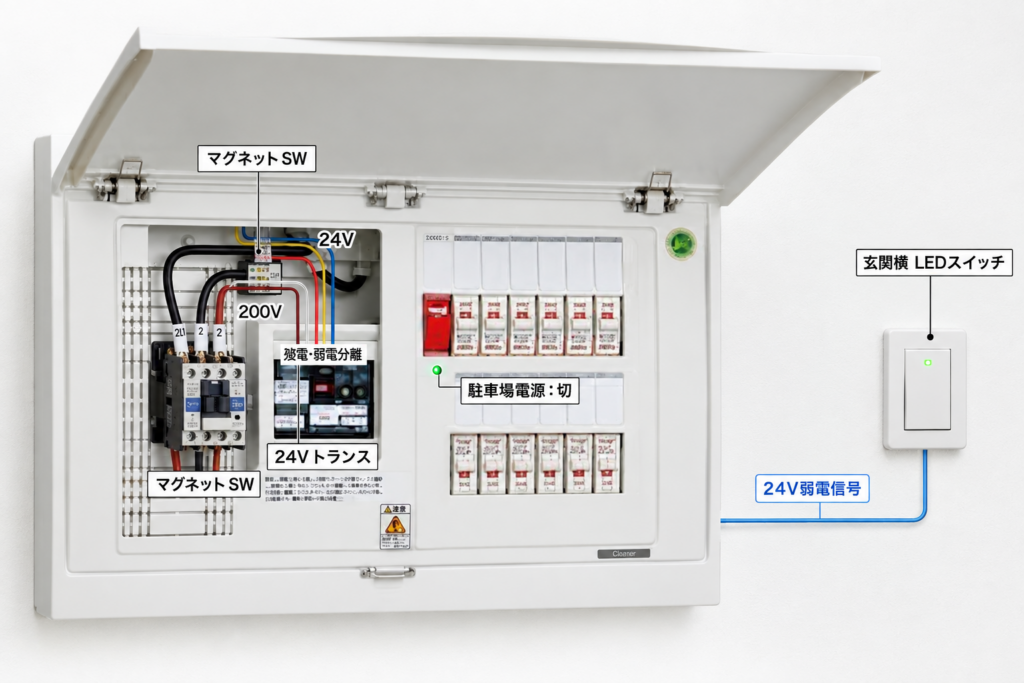
- Magnetic switch
- High-power/low voltage separation
- 24V transformer
- Parking space power: Off
- 24V low-voltage signal line
- Entry LED switch
Intellectual Property Portfolio
Regarding the unique technologies and names associated with this system and methodology, the registered utility models and filed trademark applications are as follows:
| Registered utility models (3) | Registration no. 3257129: 集合住宅における電気自動車充電設備(electric vehicle charging facility for multifamily housing) |
| Registration no. 3257709: 電気自動車用充電設備の基礎構造 (foundation structure for electric vehicle charging facilities) | |
| Registration no. 3257975: 電磁接触器一体型分電盤 (magnetic-contactor integrated distribution board) | |
| Pending trademark applications (2) | Application no. 2026-062913: (EV)カッコイーブイ ((EV) Kakko-EV) |
| Application no. 2026-077441:カッコイーブイベースコン (Kakko-EV base-con) |
*As of October 29, 2026
Business expansion roadmap
To promote the nationwide rollout of (EV) Kakko-EV, we will select several licensee companies to oversee operations across respective regions and deploy the system through an exclusive regional licensing model. By having these licensee companies collaborate with local repair and renovation contractors, as well as architectural and construction firms, we will advance the simultaneous implementation of (EV) Kakko-EV alongside large-scale repair projects, thereby driving adoption across existing properties.
For new property developments, Kakko-EV base-con is partnering with real estate developers, general contractors, electrical installation firms, and design studios to integrate EV charging infrastructure from the planning and design stages.
Driven by the philosophy of being “simple, logical, and groundbreaking,” Kakko-EV base-con promotes the development of EV charging environments in multifamily housing—regardless of whether they are existing or new builds—and takes on the challenge of an “apartment EV infrastructure revolution” to realize a “future where anyone can charge at home.”
Moving forward, while assessing market response and customer needs following this release, we will proceed with commercializing related products as ready-made offerings and collaborate with partner manufacturers to steadily advance nationwide rollout. Furthermore, we also have in view the overseas expansion of (EV) Base-Con to markets such as Taiwan, as well as proposals tailored for detached single-family homes.
Company Overview
Company Name: Kakko-EV base-con Inc.
Representative: Harutoshi Tanaka, Representative Director
Headquarters: 3-30-814 Sakuramachi, Chuo Ward, Kumamoto City, Kumamoto Prefecture, 860-0805, Japan
Core Business: Design, service, and licensing of EV charging infrastructure systems for multifamily housing
Email: info@kakko-ev.co.jp
Telephone number:+81-96-227-7718
Website: https://kakko-ev.co.jp/
Media Contact
Kakko-EV base-con Inc. PR: Tanaka